In 2024, 2,636 people were killed in crashes involving a teen driver, with 825 deaths occurring between Memorial Day and Labor Day. And while in the U.S., the federal minimum legal age for drinking alcohol is 21, many states allow teens to legally drink alcohol in specific contexts. These include, while accompanied by a parent, legal guardian, or spouse, or for religious or educational reasons.
For example, in over 30 states, teens can drink legally on private property if they’re with a parent, guardian, or spouse of legal drinking age. Many states also feature exemptions that mean minors can drink during religious ceremonies or for educational reasons, and handle, carry, and serve alcoholic beverages if it’s part of an official role.
In this study, we’ll consider how state laws vary around legal teen alcohol consumption. We’ll also look closely at the effects of alcohol consumption on young drinkers and how teen DUI rates vary across the U.S.
First, let’s consider some broad context regarding the minimum legal drinking age and evolving countrywide young drinking habits.
U.S. Underage Drinking: Laws and Trends
After Prohibition, most U.S. states adopted the minimum legal drinking age (MLDA) of 21. Between 1970 and 1975, 29 states lowered their MLDA to between 18 and 20, usually as a response to the voting age also being lowered.
Contemporaneous studies found that traffic crashes involving young people increased in states that lowered their MLDA. There was also public concern over ‘blood borders’ (which refers to underage drinkers driving into neighboring states that feature lower MLDAs to legally drink before crashing during the return drive).
Today in the U.S., the universal MLDA is 21 under the National Minimum Drinking Age Act of 1984. States that raised their MLDA to 21 before the national law was imposed enjoyed a 16% reduction in road crashes. Once all states adopted an MLDA of 21, the percentage of drinkers under the age of 21 also declined.
From 1985 to 1991, alcohol use among people aged between 18 and 20 fell from 59% to 40% (nearly 20%), while drinking among people aged between 21 and 25 dropped from 70% to 56% (almost 15%).
Many states also feature social host laws that make sure property owners are held responsible for underage drinking events on their property (or if they’re renting it) irrespective of who supplied the alcohol. This factor is attributed to further lowering the number of young drinkers.
Despite falling numbers of underage drinkers, according to CDC data, alcohol is the drug most commonly used by people under the age of 21 in the United States. In a 2023 survey of high school students, 22% reported drinking alcohol over the previous 30 days: that’s more than the number that used electronic vapor products (17%), the number that used marijuana (17%), or the number that smoked cigarettes (4%).
The same 2023 survey found that 16% of students had been in a car with a driver who had been drinking during the previous month; 5% of students who had driven admitted to doing so after taking a drink.
Underage drinking increases the chances of developing physical and mental health problems. It can also lead to social, academic, and legal difficulties. And it can cause long-term brain impairment, as the brain doesn’t stop developing until a person is 25 years old.
Around 4,000 people under the age of 21 die every year due to drinking too much alcohol. According to the CDC, underage drinking cost the United States an estimated $24 billion in 2010 (that’s the most recent year for which data is available).
Yet, as mentioned, the rules change from state to state, despite a blanket minimum legal drinking age.
Call or text (800) 900-0000 or complete a Free Case Evaluation form
Underage Alcohol Consumption Laws by State
Although you can legally drink alcohol from the age of 18 in Puerto Rico and the U.S. Virgin Islands, visitors to these U.S. territories can’t legally purchase alcohol there and bring it back to any of the 50 states.
In 2024, around 7 in 10 of the 4.2 million people who drank alcohol for the first time during the previous year were under the age of 21 (70.7 percent or 3 million people). And around 6.4 percent (1.7 million people) of adolescents aged between 12 and 17 also took their first drink.
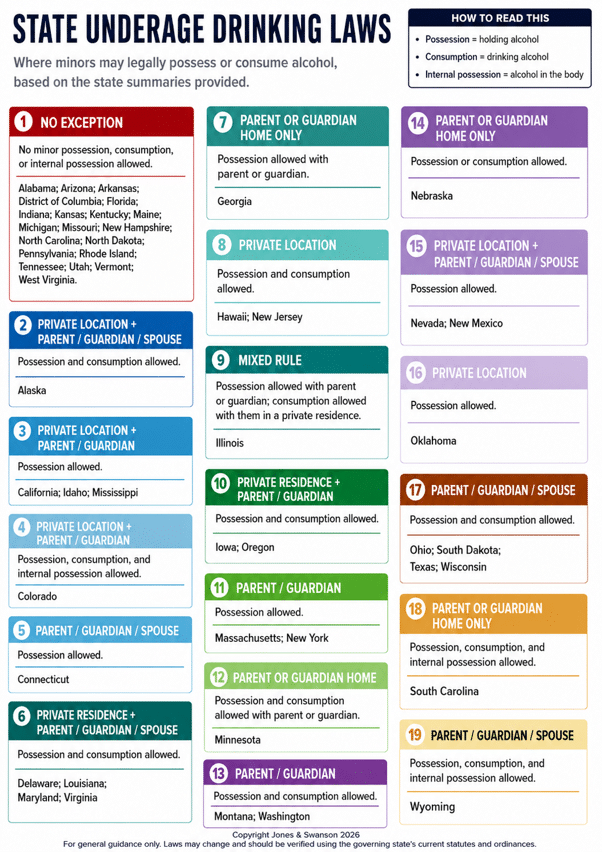
And while the national 21 years of age legal drinking threshold applies across all states, data from the Alcohol Policy Information System (APIS) tells us that 31 states allow underage alcohol consumption under very specific circumstances.
States such as Alabama, Florida, Kansas, Michigan, and Utah do not allow minors to possess or consume alcohol under any circumstances. However, Georgia allows minors to possess (but not consume) alcohol as long as they’re accompanied by a parent or guardian and they’re at home (but under no other circumstances).
In Massachusetts and New York, minors can possess (but not consume) alcohol in any environment as long as they’re accompanied by a parent or guardian. In South Carolina, if you’re a minor, you can possess and consume alcohol at home as long as you’re accompanied by a parent or guardian.
And in Hawaii and New Jersey, minors are allowed to possess and consume alcohol in a private setting. For an at-a-glance national guide of all specificities and comparative nuances, the following infographic provides all distinctive state regulations.
The Effects of Underage Drinking
Research shows that teens across the United States tend to overestimate how much alcohol their peers consume. The belief that ‘everyone else is doing it’ increases the likelihood that someone underage will drink, even if they’re worried about the consequences of breaking state or national laws.
Among adolescents aged between 12 and 17, the percentage who suffered from an Alcohol Use Disorder (AUD) during the previous year remained consistent between 2021 and 2024. In 2024, 3% (775,000 adolescents) had a past-year AUD. Additionally, 7.6% (2.9 million) of underage people had indulged in a drinking binge during the previous month, while 1.5% (576,000) were heavy consumers of alcohol.
For all underage drinkers of alcohol, the consequences extend beyond legal and enforcement matters.
Underage Drinkers and Mental Health
In 2024, SAMHSA reported that 792,000 adolescents aged between 12 and 17 concurrently experienced a major depressive episode (MDE) and a substance use disorder (SUD). Of these, 27.9% were not treated for a mental health or a substance use issue; just 18.1% were treated for both.
The 2024 National Survey on Drug Use and Health found adolescents with an MDE were more likely to use substances than those without. The following table emphasizes the disparity.
| Substance consumed | With an MDE | No MDE |
|---|---|---|
| Illicit drug (previous year) | 32.6% | 11.6% |
| Marijuana (previous year) | 25% | 7.8% |
| Opioid misuse (previous year) | 2.8% | 1.3% |
| Alcohol (previous month) | 6.2% | 3% |
| Tobacco/Nicotine vape (previous month) | 16.9% | 4.7% |
Mental illness and alcohol misuse often combine. One study found that among people who were dependent on alcohol, 37% suffered from an anxiety disorder, 29% had a mood disorder, and 28% had a major depressive disorder.
Another study found that among people with alcohol dependency, 25% had a personality disorder, 16% had a mood disorder, and 16% had an anxiety disorder. And the Journal of the American Medical Association claims that about 50% of people suffering from severe mental illness also have a substance use disorder.
Physical Health
And the physical consequences of drinking are also significant. Between 2020 and 2021, the leading alcohol-attributable causes of death in the U.S. were liver disease, heart disease and stroke, poisoning, accidents (including inebriated falls and vehicle crashes), and alcohol-related cancers.
CDC estimates also confirm that:
- 21% of people who died by suicide were found to have a blood alcohol concentration (BAC) of 0.10% or higher
- Alcohol was involved in 1 in 6 (16%) drug overdose deaths during 2022.
And those who start drinking while underage are disproportionately likely to become alcoholically dependent. A major study found that individuals who began drinking before they turned 15 developed alcohol dependency at a rate four times higher than those who began drinking when they were aged 20 or older.
Age, Race, and Gender
According to the 2024 NSDUH, among people aged between 12 and 20 who drank alcohol during the previous month:
- 7.7% took alcohol from their own home
- 12.1% got it from a parent or guardian
- 12.5% got it from a family member aged 21 or older.
Overall, 12.7 million people aged between 12 and 20 (32.9%) said they’d consumed alcohol at least once. This included:
- 6.2 million males (31.4%)
- 6.5 million females (34.4%)
- 80,000 American Indian or Alaska Native people (29.9%)
- 427,000 Asian people (17.5%)
- 1.4 million Black or African American people (27.3%)
- 6.8 million White people (36.3%)
- 491,000 people of two or more races (34%)
- 3.4 million Hispanic or Latino people (33.1%).
In 2023, about 1 in 100 children aged between 12 and 13 said they’d drunk alcohol during the previous month, compared with nearly 1 in 7 among those between 16 and 17.
NIAAA defines binge drinking as that which reaches a BAC level of 0.08 g/dL or higher (this means around 4-5 drinks for adults). Because adolescents have a lower tolerance threshold and reach this level with fewer drinks, estimated binge amounts for children are:
- 3 drinks (boys aged between 9 and 13)
- 4 drinks (boys aged between 14 and 15)
- 5 drinks (boys aged between 16 and 17)
- 3 drinks (girls aged between 9 and 17).
NIAAA’s 2024 data showed that previous-month drinking was slightly higher among females (14.3%) than among males (12.4%). Binge drinking was also higher among females (8.3%) than among males (7.1%). In terms of race and ethnicity, binge drinking was highest among young White people (9.6%), followed by young Hispanic people (6.5%) and young Black people (5.5%).
Federal law sets the BAC limit for drivers under the age of 21 at 0.02%, while many states impose elevated penalties for drivers with BAC levels of 0.15% or higher. In any case, there’s been a consistent level of teen DUI crashes during recent years, with some states subject to disproportionately high rates of teen DUI accidents.
Call or text (800) 900-0000 or complete a Free Case Evaluation form
States with the Most Teen DUIs and Teen Fatalities
2023 NHTSA data found young male drivers were involved in fatal crashes at a rate of 60.94 per 100,000 licensed drivers (compared with 22.47 for female drivers). CDC also reported that among drivers aged between 15 and 20 who were involved in fatal crashes, 24% of males and 17% of females had been drinking before they took the wheel, while 17% had a BAC of 0.08% or higher.
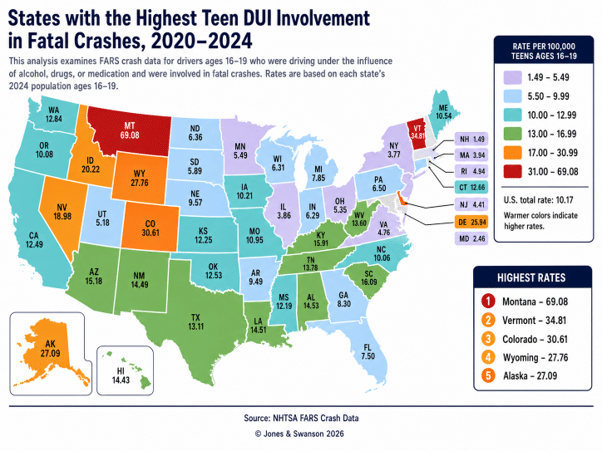
Between 2020 and 2024, 1,828 drivers between the ages of 16 and 19 who drove under the influence of alcohol, drugs, and/or medication were involved in a fatal crash. Between May 15, 2025, and May 15, 2026, the FBI crime data recorded 4,583 DUI arrests among people aged between 10 and 17 (3,489 males and 1,094 females).
When we consider the picture regarding alcohol-impaired teen drivers, there’s significant variance between states. In particular, Montana features almost double the teen DUI fatality rate of second-placed Vermont. Here are the 10 States that featured the highest rate of teen DUI drivers involved in a fatal crash between 2020 and 2024.
| Rank | State | 2024 Population Aged 16-19 | Total | Total Rate |
|---|---|---|---|---|
| 1 | Montana | 56,457 | 39 | 69.08 |
| 2 | Vermont | 34,472 | 12 | 34.81 |
| 3 | Colorado | 307,115 | 94 | 30.61 |
| 4 | Wyoming | 32,422 | 9 | 27.76 |
| 5 | Alaska | 36,908 | 10 | 27.09 |
| 6 | Delaware | 53,981 | 14 | 25.94 |
| 7 | Idaho | 123,641 | 25 | 20.22 |
| 8 | Nevada | 158,097 | 30 | 18.98 |
| 9 | South Carolina | 292,107 | 47 | 16.09 |
| 10 | Kentucky | 238,902 | 38 | 15.91 |
Conversely, these are the 10 states that featured the lowest rates of impaired teen drivers who were involved in a fatal crash during the same period.
| Rank | State | 2024 Population Aged 16-19 | Total | Total Rate |
|---|---|---|---|---|
| 1 | New Hampshire | 67,055 | 1 | 1.49 |
| 2 | Maryland | 324,848 | 8 | 2.46 |
| 3 | New York | 981,626 | 37 | 3.77 |
| 4 | Illinois | 673,428 | 26 | 3.86 |
| 5 | Massachusetts | 380,404 | 15 | 3.94 |
| 6 | New Jersey | 475,728 | 21 | 4.41 |
| 7 | Virginia | 462,211 | 22 | 4.76 |
| 8 | Rhode Island | 60,755 | 3 | 4.94 |
| 9 | Utah | 231,443 | 12 | 5.18 |
| 10 | Ohio | 616,702 | 33 | 5.35 |
Jan
0.61
110
Feb
0.68
122
March
0.65
116
April
0.71
127
May
0.98
176
June
1.16
209
July
0.87
156
Aug
0.95
170
Sept
0.96
173
Oct
0.91
163
Nov
0.81
146
Dec
0.89
160
Methodology
The above analysis draws on five years of FARS crash data regarding drivers aged between 16 and 19 who were driving under the influence of alcohol, drugs, or medication and who were involved in a fatal crash. Rates reflect the cumulative 2020-2024 total per 100,000 residents aged between 16 and 19.
Current Teen Drinking Trends
SAMHSA data suggests that previous-month alcohol intake among people aged between 12 and 20 fell from 15.6% in 2021 to 13.3% by 2024.
Since 2000, past-year alcohol use has fallen significantly, by:
- 73% to 41% among 12th graders
- 65% to 24% among 10th graders
- 43% to 11% among 8th graders.
Binge drinking (consuming five or more drinks in a row during the previous two weeks) remained consistent between 2024 and 2025, but has declined significantly since 2000, by:
- 30% to 9% among 12th graders
- 24% to 2% among 10th graders
- 12% to 1% among 8th graders.
Extreme binge drinking (10 or more drinks), plus beer and alcopop drinking, has also fallen significantly since tracking began. Study data also confirmed that peer attitudes to drinking are increasingly negative.
In 2025, 76% of students felt their peers disapproved of weekend binge drinking, which coincided with historically low binge-drinking rates: just 1.4% of 8th graders, 3.9% of 10th graders, and 8.7% of 12th graders, suggesting they’d drunk five or more drinks in a row during the previous fortnight.
Call or text (800) 900-0000 or complete a Free Case Evaluation form
Conclusion
In the United States, the minimum legal drinking age is 21; that said, 31 states allow limited exceptions for underage alcohol consumption (such as when supervised by a parent or guardian, or for religious or educational purposes).
These exceptions are part of a broader framework involving the National Minimum Drinking Age Act of 1984, which contributed to a 16% reduction in alcohol-related traffic crashes once states adopted a minimum age of 21.
Although underage drinking has significantly declined over the past two decades, alcohol is nonetheless the most popular substance used by Americans under the age of 21. In 2024, 13.3% of people aged between 12 and 20 reported that they’d drunk alcohol during the previous month, while 3% of adolescents were reported as suffering from an Alcohol Use Disorder.
Underage drinking can cause long–term brain impairment, as the brain doesn’t stop developing until a person is 25 years old
Underage drinking is associated with an increased risk of motor vehicle crashes, mental illness, alcohol dependence, impaired brain development, and thousands of preventable deaths every year. Adolescents with depression are also far more likely to misuse alcohol and other substances than their peers.
Crash data from between 2020 and 2024 identified 1,828 impaired drivers aged between 16 and 19 who were involved in fatal crashes, with Montana (by some distance), Vermont, and Colorado recording the highest DUI fatality rates and New Hampshire, Maryland, and New York the lowest. Fatal teen DUI crashes were most common during the summer months, particularly in June.
Despite these risks, national trends are encouraging. Long-term surveys show a substantial decline in alcohol use and binge drinking among middle and high school students since 2000. Peer disapproval of binge drinking has reached record highs, coinciding with historically low levels of youth alcohol use, which suggests that changing social attitudes continue to reduce underage drinking.
Yet a lack of consistency across the country when it comes to outright underage restrictions regarding the legal use of alcohol, and vast differences in ordinance between adjacent states (that on occasion lead to teen drunk-driving crashes and fatalities) remain significant issues. It’s also clear that health consequences regarding the use of alcohol at a too-early age can have calamitous long-term effects.
As things stand, a national minimum legal drinking age of 21 is often easily bypassed due to state exceptions. It seems likely that a more universally applied definitive system would further encourage promising trends and improve health outcomes for the young people of the United States.
If you or a loved one has been hurt in a car accident caused by an intoxicated driver, you’re probably dealing with a painful injury and may be unsure about how you’re going to cover your medical bills and other accident-related expenses. Fortunately, a Jones & Swanson lawyer can help you get the damages you deserve.
Our firm has over 50 years of combined experience representing victims of drunk driving accidents and other incidents. You can count on our Marietta drunk driving accident lawyer to represent your best interests and provide you with the compassionate support you need to negotiate a challenging time.
Call or text (800) 900-0000 or complete a Free Case Evaluation form