
A Los Angeles jury recently ordered Chris Brown to pay $12.9 million to his former housekeeper, Maria Avila, after she was mauled by his dog (additional damages were awarded to Maria’s sister and husband).
Yet dog bites are no niche celebrity issue. According to the Insurance Information Institute’s Spotlight on Dog Bite Liability report (produced with State Farm), dog bite and dog-related injury claims filed with US homeowner insurers rose from 22,658 in 2024 to 28,450 in 2025: that’s a 25.6% rise in a single year.
In this study, we’ll consider the growing dog bite problem in the United States. We’ll uncover the dog bite danger zones: where victims face the highest risk and the weakest legal protections. We’ll also assess associated medical factors and employment risks.
Let’s first consider the rise in fatalities due to dog bites in the U.S.
The Rising Cost and Risk of Dog Bite Claims
While dog bite claims are becoming increasingly expensive as medical costs, settlements, and jury awards continue to rise, the number of serious incidents is also on the rise. CDC Wonder recorded 127 fatal dog attacks in 2024: that’s the highest number ever recorded and a 165% increase on 2019’s 48 dog bite deaths.
In the U.S., there are an estimated 4.5 million dog bite incidents every year, with children affected far more than adults. And rising dog ownership may partially explain the dog bite increase: by 2025, 71 million U.S. households owned dogs, with the number of households featuring dogs increasing from 51% to 53%.
But where do potential dog bite victims face the greatest risks, not merely of an attack but of subsequent legal and financial obstacles?
Call or text (800) 900-0000 or complete a Free Case Evaluation form
Where Victims Face the Greatest Dog Bite Risks
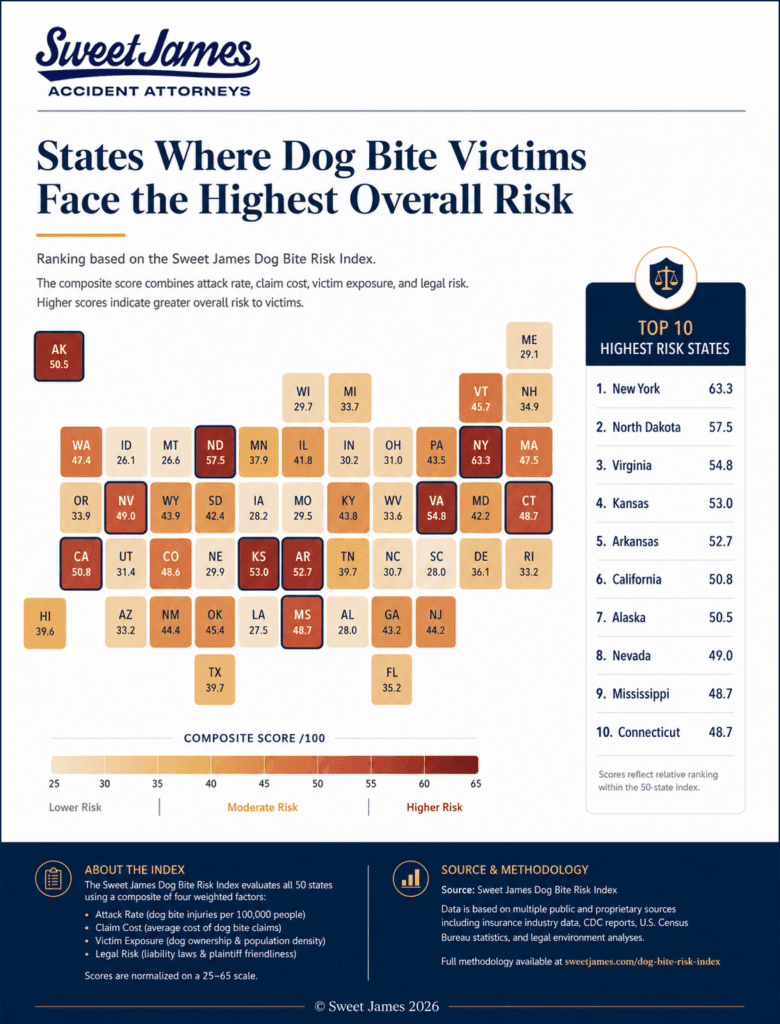
The Sweet James Dog Bite Risk Index measures overall victim burden as opposed to mere vulnerability to attack. The index combines factors such as attack frequency, claim costs, victim exposure, and legal protections.
Subsequently, smaller states may rank higher than larger states that feature a higher number of claims.
Call or text (800) 900-0000 or complete a Free Case Evaluation form
Overall Risk Rankings
New York ranks No. 1 with a composite score of 63.3/100. This score is driven by the highest average claim costs and one of the highest victim exposure scores. (Note: since the gathering of the data for this study, New York has made significant changes to its legal framework following Flanders v. Goodfellow (2025).)
The other highest-ranking states are:
North Dakota, Virginia, Kansas, Arkansas, California, Alaska, Nevada, Mississippi, and Connecticut.
Call or text (800) 900-0000 or complete a Free Case Evaluation form
Key Risk Factors
Risk of Dog Bite Attack
Florida ranks No. 1 for dog bite attacks with a score of 100.0 (despite earning a low overall ranking). Other high-ranking dog bite attack states include New York, North Dakota, Virginia, Kansas, Arkansas, Alaska, Nevada, Connecticut, and Mississippi.
Texas recorded the lowest attack-rate score, while California ranked close to the bottom despite ranking sixth overall: this is one of many clear demonstrations throughout this study that one single factor (in this case, frequency) does not determine total risk.
Claim Cost Risk
New York ranks first for claim costs with a score of 100 and an average claim value of $110,488. California ranks second ($86,229), followed by Texas ($75,674) and Illinois ($73,797).
These high costs reflect injury severity, medical expenses, and settlement values as opposed to the frequency of attacks.
The financial consequences of severe attacks can be substantial. The largest known U.S. dog bite verdict is the aforementioned $12.9 million Chris Brown judgment. Other major case sums include:
- $5.4 million (Los Angeles, 2026): A victim was awarded hefty damages following a severe attack involving a dog with an alleged prior bite history at an animal shelter.
- $5 million (Lexington, 2025): A jury awarded this huge settlement after a dangerous dog attack, with the property owner in this case held most liable.
- $3.76 million (Florida): A jury adjudged that both animal control and the dog owner were culpable after repeated complaints preceded an attack.
- $2.3 million (California): This facial injury case involved significant reconstructive surgery that led to a sizable settlement.
Victim Exposure Risk
Connecticut tops the ranking when it comes to victim exposure with a score of 100, followed by:
- Massachusetts (95.2)
- Washington (94.9)
- California (91.6)
- New York (83.2)
- New Jersey (81.9)
Mississippi ranks lowest, followed by states including West Virginia, South Dakota, Idaho, Montana, and Kentucky.
Legal Risk
Legal protections vary across states. North Dakota, Kansas, Arkansas, and Mississippi rank highest for legal risk, each scoring 100 due to featuring no specific dog-bite statute.
Other states feature high legal risk due to their one–bite rule systems, which generally means victims must prove the owner knew the dog posed a danger before liability can be established.
Call or text (800) 900-0000 or complete a Free Case Evaluation form
Where Dog Owners Face the Least Accountability
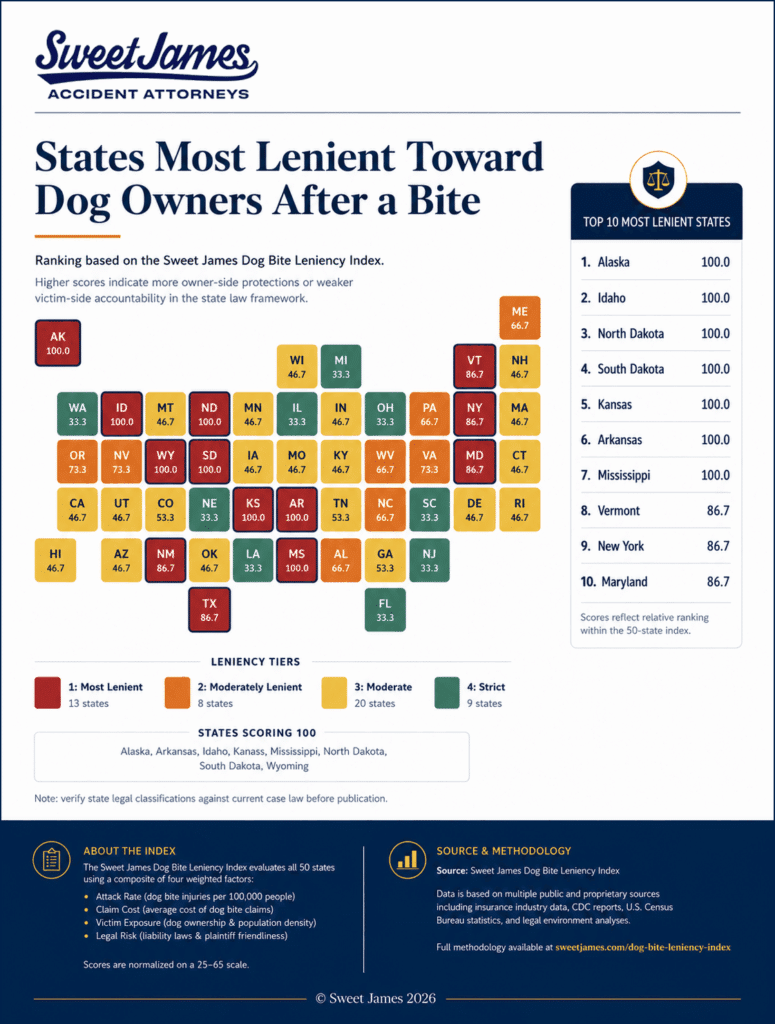
Because dog bite laws vary significantly by state, this creates major disparities regarding the extent to which owners are held accountable after a serious incident. The Leniency Index measures accountability gaps (not whether a state is ‘pro-dog owner’) by evaluating factors like owner penalties, euthanasia requirements, and available legal protections after an attack.
States Featuring the Most Lenient Laws
We rank thirteen states as ‘lenient’ and attribute the highest scores (100.0) to:
Alaska, Arkansas, Idaho, Kansas, Mississippi, North Dakota, South Dakota, and Wyoming.
Another group (including Maryland, New Mexico, New York, Texas, and Vermont) earned a leniency score of 86.7.
We ranked eight states as ‘moderately lenient’: Nevada, Oregon, and Virginia each scored 73.3, with all three carrying a one-bite rule. While the maximum owner penalty following a dog bite in both Nevada and Oregon is a felony charge, the remaining ‘moderately lenient’ states usually cap penalties as misdemeanors. Somewhat less lenient were Alabama, Maine, North Carolina, Pennsylvania, and West Virginia, all of which we rated with a score of 66.7.
Moderate and Strict Accountability States
We ranked twenty states as ‘moderate’: Colorado, California, Connecticut, Georgia, Hawaii, Indiana, Iowa, Kentucky, Massachusetts, Minnesota, Missouri, Montana, New Hampshire, Oklahoma, Rhode Island, Tennessee, Utah, and Wisconsin.
Colorado and Georgia charge owners of dogs who bite with felony-level penalties, while most other moderate states apply only misdemeanor charges.
Some states feature mandatory euthanasia laws, including:
- Colorado (if a bite causes serious injury)
- Georgia (if an owner is non-compliant)
- Tennessee (if an owner fails to appear)
We rank nine states as especially strict: Florida, Illinois, Louisiana, Michigan, Nebraska, New Jersey, Ohio, South Carolina, and Washington.
Among strict states, the following distinctions apply.
- Nebraska allows felony/death-level penalties.
- Michigan allows felony manslaughter charges.
- Ohio allows felony penalties and mandates insurance coverage for future incidents.
- New Jersey and Washington combine misdemeanor-level penalties with mandatory euthanasia stipulations.
Gaps in Euthanasia Mandates and Criminal Penalties
Eight states don’t insist on mandatory dog euthanasia after qualifying attacks: Alaska, Arkansas, Idaho, Kansas, Mississippi, North Dakota, South Dakota, and Wyoming.
Seven states feature mandatory euthanasia when a dog attacks to a qualifying degree: Virginia, Louisiana, New Jersey, Colorado, Georgia, Washington, and Tennessee.
Three states (Arkansas, Kansas, and Mississippi) feature no maximum owner penalty laws, while Nevada, Oregon, and Nebraska allow the most severe penalties, including felony/death-level convictions.
How Dog Owner Liability Works
According to the Insurance Information Institute, dog owner responsibility generally falls into the following three legal categories.
- Dog–bite statutes
Owners are automatically liable for injuries their dogs cause, even if there’s no prior history of any attacks.
- One–bite rules
In this case, victims must prove that the owner was aware of the dog’s dangerous tendencies.
- Negligence laws
Owners are liable if injuries were the result of a failure by them to reasonably control their dog.
In especially severe cases, owners may face criminal charges. One illustrative example occurred in California, an incident during which the owners of Presa Canario dogs killed a neighbor.
One owner was convicted of second-degree murder, while the other faced charges of involuntary manslaughter. This was only the third time U.S. dog owners faced murder charges for a fatal dog attack.
The American Workplace Dog Bite Injury Risk
Dog bites are not merely a public health issue: they’re also a growing workplace safety concern. During 2025, USPS reported more than 5,200 dog attacks on postal employees. The highest recorded number of city incidents occurred in Los Angeles (70), Dallas (50), Denver (45), Houston (44), and Chicago (43). By state, California (673 incidents) led the nation, followed by Texas (358), Ohio (287), New York (269), and Pennsylvania (267).
To reduce employee risk, USPS provides carriers with protective satchels, dog repellent, route scanner alerts, and warning cards covering addresses that feature well-known aggressive dogs. Yet it’s not just mail carriers who are at risk. Delivery drivers, utility workers, landscapers, contractors, housekeepers, and home health assistants all face the potential of a confrontation with a dangerous dog whenever they enter a home or yard.
A survey of 1,000 delivery drivers emphasizes the severity of the problem: 94% say they’ve been bitten by a dog, and 80% suggested they’d reported the incident to their employer. Employer responses range from providing medical care, filing official reports, and contacting pet owners for compensation or vaccination records.
Dog bite risk also affects animal-care professionals. Studies suggest that up to 63% of veterinarians and 48% of veterinary technicians are bitten by dogs throughout their careers. Additionally, the U.S. Bureau of Labor Statistics reports that non-farm animal caretakers suffer the most workplace animal-related injuries, including dog and cat bites.
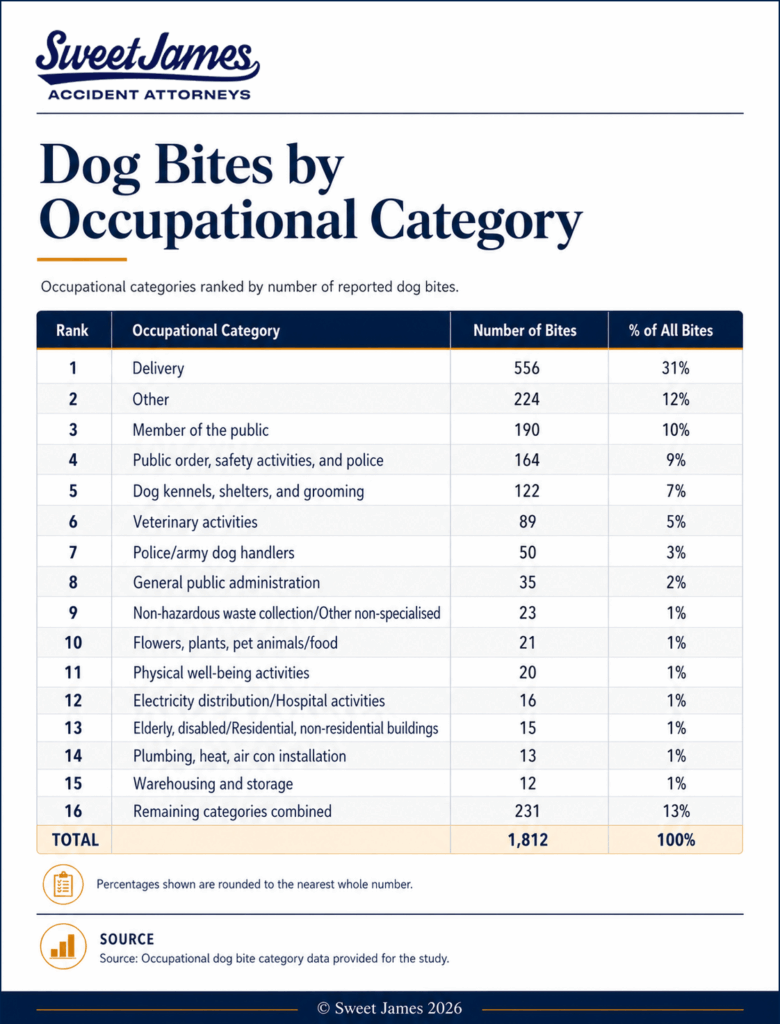
A 2019 UK study lists the number of dog bites by occupational categories as defined in the Standard Industrial Classification. That’s the standard industry classification, developed by the Office for National Statistics. Here are the top 10 groups regarding their risk of suffering a dog bite attack.
The Medical and Financial Toll of Dog Bite Claims
In the United States, dog bites are a significant public health and financial burden. According to the CDC, they account for 85-90% of all animal bites, lead to 337,000 emergency department visits every year, and leave nearly one in five victims requiring medical attention. About 18% of bites become infected, with children far more likely than adults to suffer a serious injury.
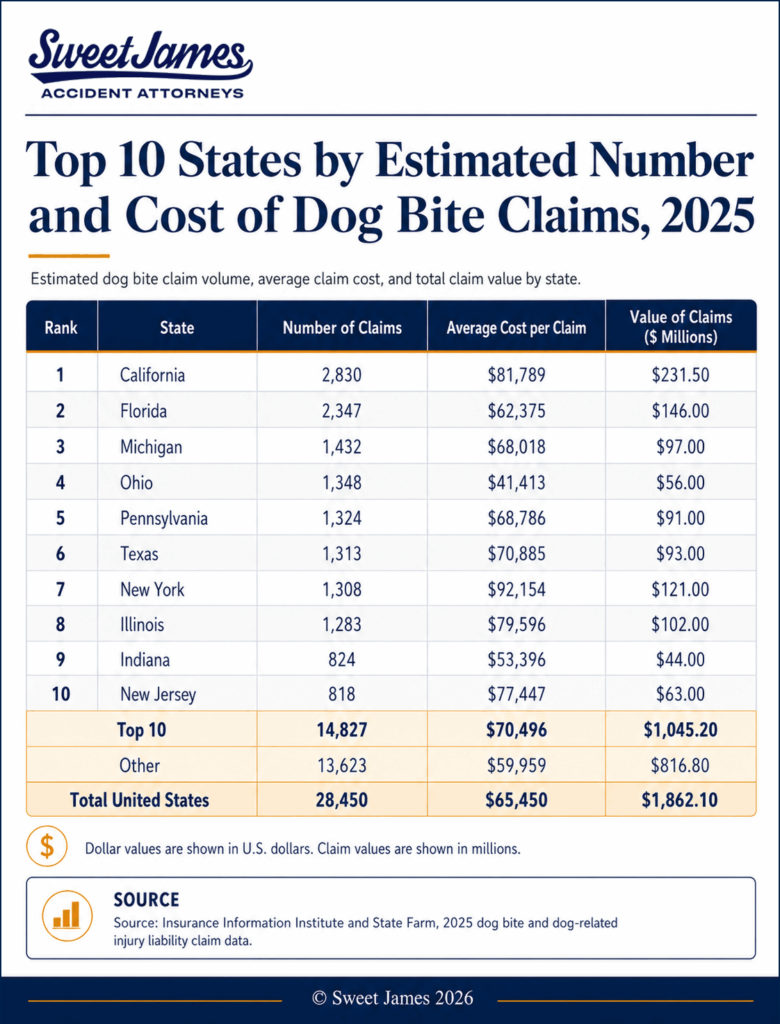
The severity of the financial impact of dog bites continues to worsen. Dog-related liability claims reached $1.862 billion in 2025, at an average payout of $65,450 per claim.
Claim costs have increased 209% since 2016, driven by both rising medical expenses and growing legal settlements; the number of claims has risen 97% over the past decade, 18.6% since 2024.
California and Florida recorded the highest number of claims, while New York was subject to the nation’s highest average claim value ($92,154).
Medical costs are also significant. AHRQ/HCUP estimates the average dog bite-related hospital stay lasts 3.3 days and costs $18,200: 50% more than the average injury-related hospital stay.
Over 57% of hospitalized victims require surgery, emphasizing the severity of most dog bite injuries. Common diagnoses include infections, open wounds, and fractures.
Dog bites are also associated with broader healthcare trends. Over 40% of emergency department visits and hospitalizations are billed to private insurance, while rural areas experience four times as many emergency visits and three times as many hospital stays as urban communities. Emergency visit rates are the highest of all in the Midwest and Northeast.
The Sweet James Victim Cost Model estimates that a serious dog bite that requires a hospital stay costs victims between $23,222 and $26,330. That’s after we’ve combined medical expenses, around 3.5 weeks of lost wages, and projected mental health treatment costs.
Connecticut ranks highest for victim cost exposure at $26,330. Similar rates apply to Massachusetts, Washington, California, New York, New Jersey, Maryland, Colorado, Illinois, and Virginia. Mississippi features the lowest modeled cost ($23,222).
For dog owners, the financial risk may extend beyond insurance. Standard homeowner and renter policies usually provide between $100,000 and $300,000 in liability coverage, leaving owners personally responsible for damages that exceed those thresholds.
Methodology
The Sweet James Victim Cost Model estimates the overall cost of a serious dog bite that involves hospitalization by combining associated medical costs, lost wages, and mental health treatment. The model uses a baseline of $18,200 in medical costs, plus 3.5 weeks of lost wages, plus expected mental health treatment costs of $1,200.
Dog Bites In The United States: An Escalating Problem
Dog bites are an escalating public health, legal, and financial issue in the United States. CDC Wonder recorded 127 fatal dog attacks in 2024, the highest on record and a 165% increase from 2019 figures, while an estimated 4.5 million dog bites occur every year. Rising dog ownership (there are now 71 million dog-owning households) will likely increase exposure.
The Sweet James Dog Bite Risk Index ranks states based on the combined victim burden, not just attack frequency: we measure claim costs, victim exposure, legal protections, and attack rates to assess overall risk.
New York ranks highest overall, followed by North Dakota, Virginia, Kansas, and Arkansas, while Florida leads for attack frequency. States with one-bite rules or no specific dog-bite statutes generally present greater legal obstacles for victims.
Because dog bite laws vary significantly by state, this creates major disparities regarding the extent to which owners are held accountable after a serious incident.
Medical and financial costs continue to rise. Dog-related liability claims totaled $1.862 billion in 2025, with average payouts of $65,450. Serious hospital visits cost on average $18,200, often require surgery, and can leave victims $23,000-$26,000 out of pocket in combined medical costs, lost wages, and mental health expenses. Standard homeowners’ insurance may not cover damages that exceed policy limits.
Dog bites also pose a significant threat to many U.S. workers. USPS reported more than 5,200 attacks on postal workers in 2025; delivery drivers, utility workers, landscapers, healthcare workers, and veterinarians also face significant levels of risk. Survey data found 94% of delivery drivers had been a victim of a dog bite, confirming the growing occupational threat alongside a broader public safety issue.
Ultimately, until there’s greater national parity when it comes to taking dog bite attacks seriously, where you live largely determines how protected you are against a rising national danger. As ever, taking the utmost precaution around all unfamiliar dogs and making sure you’re well protected when you go to work if your role puts you at risk are essential.
A dog attack could affect you at any moment and leave you with not only physical, but also emotional wounds, especially if your child was involved. You may face significant medical bills, while insurance companies are notorious for downplaying an incident and attributing some of the blame to you.
If you’re searching for a California dog bite lawyer, you may need someone who can step in immediately and protect your rights.
At Sweet James, we act as your dog bite lawyer from the beginning. We’ll help you understand your options and shield you from insurance pressure.
Call or text (800) 900-0000 or complete a Free Case Evaluation form