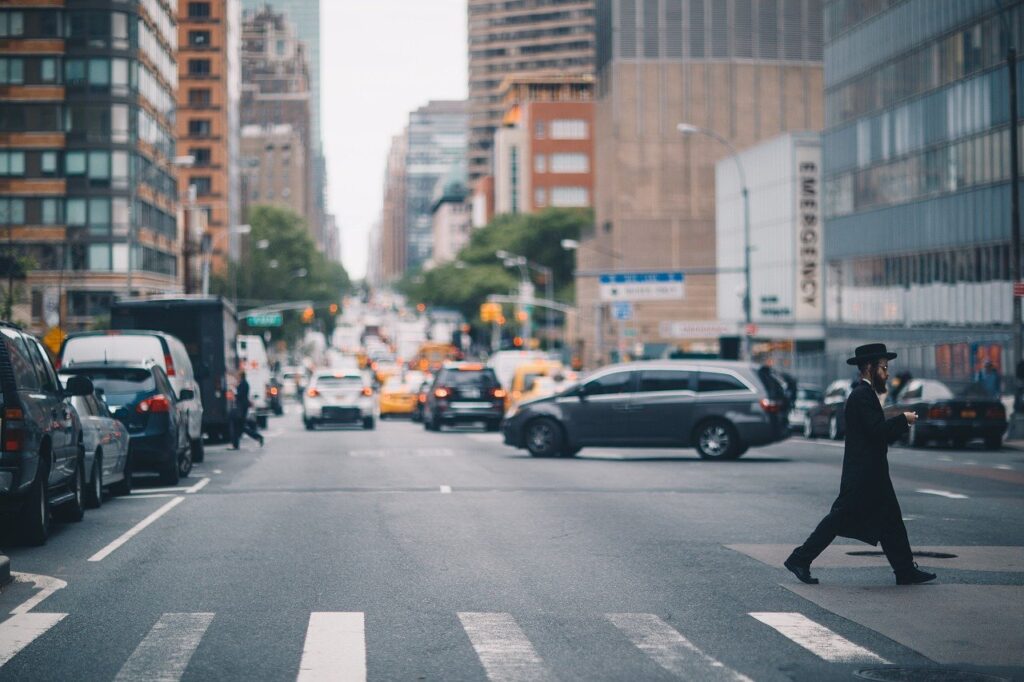
The person at fault for hitting a pedestrian in a crosswalk is usually the driver because drivers generally must yield to pedestrians crossing in marked and unmarked crosswalks.
The driver isn’t always the only one to blame, though. A pedestrian who darted out, a city with a broken signal, or a second driver can share responsibility.
Crosswalk crashes look simple on paper, yet insurers still argue over them. At Sweet James, we see adjusters question whether the spot even counted as a crosswalk, or whether the pedestrian left the curb too suddenly.
Our pedestrian accident lawyers can answer those questions with the law and the facts of your crash.
What Legally Counts as a Crosswalk?
A crosswalk is defined by law, not by paint. Under California Vehicle Code § 275, a crosswalk is either the extension of the sidewalk lines across an intersection or any part of a road marked with lines for pedestrians.
That definition covers three common kinds of crossings:
- A marked crosswalk at an intersection, with painted lines or a striped pattern
- An unmarked crosswalk at an intersection, where the sidewalks on each side line up but no paint exists
- A marked mid-block crosswalk, often near schools, parks, or transit stops
Painted lines in a store parking lot are a different situation, because private lots may fall outside the traffic laws that govern public roads. Those cases can turn on premises liability instead. Sweet James starts every crosswalk case by confirming which kind of crossing the pedestrian was using.
Why the Driver Is Usually at Fault for Hitting a Pedestrian in a Crosswalk
The duty runs mainly one way. Under California Vehicle Code § 21950, a driver must yield to a pedestrian crossing in a crosswalk, slow down, and take extra care when approaching one.
Darkness is a frequent factor in these crashes. In 2023, 77% of pedestrian deaths happened after dark, according to the NHTSA. A driver who can’t see far enough ahead to stop for someone in a crosswalk is generally driving too fast for the conditions.
Sweet James often handles cases where a driver hit a pedestrian in a crosswalk and then claimed the person “appeared out of nowhere.” That explanation rarely holds up, because a crosswalk is exactly where drivers are expected to watch for people on foot.
The Driver Who Passes a Car Stopped at a Crosswalk
Some crosswalk crashes involve two drivers. One car stops to let a pedestrian cross, and a second driver in the next lane swings around it without seeing why it stopped.
Safety engineers call this a “multiple threat” crash, and the stopped car blocks the view for both the pedestrian and the passing driver. California Vehicle Code § 21951 bars drivers from passing a vehicle that has stopped at a crosswalk to let a pedestrian cross.
The passing driver usually carries the blame in these cases, since the stopped car was a clear warning. Sweet James looks at both drivers’ insurance, because the first driver’s actions, such as waving the pedestrian across, sometimes become part of the dispute.
School Crosswalks and Crossing Guards
Children are especially exposed near crosswalks. In 2023, 17% of children 14 and younger killed in traffic crashes were pedestrians, according to the NHTSA.
California sets a 25 mph limit near schools when children are present under California Vehicle Code § 22352. Under AB 382, local authorities may adopt a 20 mph school-zone speed limit, and a 20 mph prima facie school-zone limit becomes the statewide standard on January 1, 2031. Drivers must also obey a crossing guard’s stop sign under California Vehicle Code § 2815.
Courts generally judge a child’s conduct by what a reasonable child of the same age would do, not by adult standards. That can make it harder for an insurer to shift blame onto a young pedestrian. Sweet James reviews school zone signs, guard schedules, and the driver’s speed in these cases.
When a City or Another Party Shares the Blame
A driver may not be the only party responsible for a crosswalk crash. Poor road design and maintenance can set up a collision before a driver ever arrives.
Other parties who may share fault include:
- A city or county that let crosswalk paint fade, left a signal broken, or failed to fix poor lighting
- The driver’s employer, if the driver was working at the time
- A construction contractor who blocked a sidewalk or rerouted pedestrians into traffic
How Long You Have to File After a Crosswalk Crash
Crosswalk injury claims in California usually run on a two-year clock. In California, a personal injury lawsuit against a driver generally must be filed within two years of the crash under California Code of Civil Procedure § 335.1.
Children get more time in many cases. California Code of Civil Procedure § 352 generally pauses the clock until a child turns 18, but that pause doesn’t apply to claims against a public entity. A family whose child was hurt in a crosswalk with a broken signal could still face the six-month government claim deadline.
Claims against a government agency move on a much shorter clock. In California, a personal injury claim against a public entity generally must be filed within six months under California Government Code § 911.2. Sweet James checks for a government angle early so that window doesn’t close.
Crosswalk Pedestrian Accident FAQs
These answers cover common follow-up questions after a crosswalk crash.
Does the Police Report Decide Who Was at Fault?
The police report does not decide who was at fault; it is one piece of evidence, and the officer’s opinion doesn’t bind the insurance company or a jury. Officers usually arrive after the crash and rely on statements from the people involved.
A report can still contain errors, such as a wrong lane, a missing witness, or the driver’s version of events taken at face value. Sweet James compares the report against video, photos, and witness accounts to find those gaps.
Is the Driver at Fault if the Pedestrian Was Looking at a Phone?
The driver can still be at fault if the pedestrian was looking at a phone, because the duty to yield in a crosswalk doesn’t depend on the pedestrian paying full attention. The pedestrian’s distraction may reduce the recovery in some states, but it doesn’t erase the driver’s responsibility.
Can a Pedestrian in a Crosswalk Ever Be at Fault?
A pedestrian in a crosswalk can be partly at fault, for example, by stepping off the curb so suddenly that the driver had no time to stop, which California Vehicle Code § 21950 prohibits. Even then, the driver’s speed and attention still count.
Get Help From Sweet James After a Crosswalk Crash
If a driver hit you in a crosswalk, the law usually starts on your side, but the insurer will still look for ways to shift blame. Sweet James has recovered $725,000 for a pedestrian in a Laguna Beach case. Past results do not guarantee future outcomes.
Request a free case review from Sweet James to talk through who may be at fault for hitting a pedestrian in a crosswalk. We charge no fees or costs unless we win, and our team answers 24/7 in English and Spanish.